Showing posts with label offshore software development. Show all posts

Wednesday, 4 July 2018

Common Blockchain terms that you should know about

Blockchain is represents a new standard about the way information is shared.

With blockchain's growing importance, global companies are focusing on figuring out how they can utilize the distributed ledger technology for their benefit and advantage. A significant number of companies worldwide have started to roll out distinctive pilot programs as well as real-world projects spanning a broad variety of industries, which includes healthcare, financial services, global shipping, and mobile payments.

Suffice it to say that blockchain is likely to become an integral part of at least business to begin with. This, in turn, makes it important for people to be familiar with the technology as well as certain terms that can help ensure that they aren't caught unaware in a discussion centered on blockchain.

Here's a list and explanation of a handful of important blockchain terms:

a. Bitcoin: Created in 2009, it is a widely popular cryptocurrency, based on the ideas described in a white paper by Satoshi Nakamoto. Unlike government-issued currencies, it is operated by a decentralized authority and offers lower transaction fees as compared to conventional online payment systems.


b. Addresses i.e. cryptocurrency addresses: Typically, a string of alphanumeric characters or a scannable QR code, these are used to receive and send transactions on the network.

c. Attestation Ledgers: They are distributed ledgers that offer an abiding record of commitments, statements, or agreements, thus delivering evidence i.e. attestation that these commitments, statements, or agreements were indeed made.

d. Block height: It alludes to the number of blocks linked together in the blockchain, e.g. Height 0, also referred to as the Genesis Block, will be the first block.

e. Cipher: It is the algorithm that is used to encrypt and/or decrypt information.

f. Distributed ledgers: They are a kind of database that span multiple countries, institutions, or sites wherein records are stored one after the other in a sustained ledger. Depending on who is given the permission to view it, distributed ledger data can be either permissioned or un-permissioned.

g. Node: It is essentially any computer that connects to the blockchain network. And a node that completely implements all the rules of the blockchain is called a full node.

h. Multi-signature addresses: They enable multiple parties to need more than just one key to authorize a transaction and proffer an enhanced resistance to theft. The requisite number of signatures is agreed upon during the creation of the address.

Blockchain: Use cases

Thanks to the ingenuity proffered by blockchain technology, people and companies across the world continue to seek novel ways to administer it to essentially any requirement that needs a reliable record. Blockchain has already changed a variety of things in the world. To begin with, it has practically empowered people with the power of cryptography. It has also become the centre of much hype, which is most likely a result of possible unique applications of blockchain technology.

Here are some blockchain use cases to demonstrate the potential of this technology:

 
1. Smart Contracts: They are legally-binding digitized, programmable contracts entered on the blockchain. Developers administer legal contracts as variables and statements that can release of funds using the bitcoin network as a third party executor instead of relying on a single central authority.

2. Digital identity: The annual costs for digital security run in the billions, but blockchain technologies offer the scope to turn things around by making tracking and managing digital identities efficient as well as secure, thus reducing fraud.

3. Distributed Cloud Storage: Blockchain data storage is poised to become a major disruptor in a matter of years. With Blockchain, cloud storage can become decentralized, thus enhancing security and reducing dependency.

Read Also: 

Blockchain : An Introduction  

How are payments transferred in Blockchain? 

Contact us - contact@craterzone.com

Blockchain: An Introduction By Craterzone

Blockchain, undoubtedly a unique invention, was developed by either a single person or a group of them, known by the alias Satoshi Nakamoto. Poised to revolutionize the world quite like how open-source software did two decades ago, blockchain too presents the scope to be a similar agent of change. But as it continues to evolve, there's one question that a considerable majority of the global population seems to be asking far too often:

What is blockchain?

Before we delve deeper into the topic, let us get the basics out of the way. Blockchain is defined as an electronic ledger that can be openly shared among various users and that puts together incorruptible record of the users' transactions. Each digital record a.k.a. transaction, time stamped and linked to the previous transaction, in the thread is referred to as a block, thus leading to the name blockchain. This technology allows either an open or governed group of users to participate in and access the electronic ledger. And you must also know that each block is connected to a single participant.


What this means is that blockchain can be updated only by the consensus of the participants in the ledger. And once the new data is entered in the ledger, it can neither be amended or be erased. Thus, the blockchain includes a verifiable record of every single transaction ever made in the system.

Information hosted on a blockchain exists as a shared and constantly harmonized database. Furthermore, the blockchain database isn't stored in a single location, which means the records it contains are genuinely public and easily empirical. A centralized version of this information does not exist, which means a hacker can’t corrupt it. The data, hosted by millions of computers at once, can be accessed by anyone with an internet connection.

Read Also:


contact us- contact@craterzone.com


Monday, 16 November 2015

Benefits of an Offshore Development Centre


Offshore development is a form of Outsourcing. Now, you might say 'Why Outsource' but in keeping with the latest market trends, the question you should ask is 'Why not outsource'. It is an open secret today that outsourcing works great for both big and small businesses alike. Outsourcing your work to a company, especially an IT Outsourcing Company, has become a trend and it is a tried-and-tested model today. It is now recognized as a long term competitive strategy for success and profits.

As mentioned earlier, Offshore Development is a from of Outsourcing, that deals Offshore Software Development, that is development of a software project in some foreign country. Basically the centre where Offshore Outsourcing happens is called an Offshore Development Centre. Given below are benefits of an Offshore Development Centre.


  1. These days, hiring qualified IT professionals can leave a huge dent in your budget. However, the salaries of IT professionals in countries such as India is comparatively lesser than their counterparts in the US and other developed countries.
  2. Outsourcing can give you the opportunity to have access to the best possible technology and skilled manpower. It is an open secret that countries such as India produce a large number of qualified IT professionals who are extremely skilled at what they do. Moreover, Indian Outsourcing Companies also have a highly diversified set of professionals in their payroll. Moreover, offshore outsourcing companies focus heavily on innovation, quality and are continuously on a lookout for improvement. Thus, you stand in a chance to get strong expertise  with highly experienced team of experienced professionals if you hire them.
  3. Offshore Development Centre:operate at high levels of efficiency, and reliability. You can get access to quality processes operating at the highest possible software development quality. This ensures minimum error rate and rework.
  4. Hiring an offshore outsourcing company can ensure that you already have access to an already functioning infrastructure provided by any Offshore Development Centre to start your projects. This considerably, shortens project start-up time span.
  5. Involvement of many skilled professionals and teams greatly reduces the risk of project failures. This provides significant advantage when managing service level agreements.
  6. As work allocation happens at a different location and task accomplishment happens at different location, the time ideally taken for development reduces considerably.
  7. No extra or new infrastructure is needed to complete your projects. As mentioned above, Offshore Development Centre come equipped with all the basic infrastructure and hence you can just go ahead and start your project without having the need to develop any other infrastructure.
  8. One can get high quality work from the skilled offshore team, without much training. In case, you are not satisfied with the work done on your project, you can always ask the work to redone, without incurring additional costs.

Saturday, 11 July 2015

IT Offshore Outsourcing Services In India

Offshore Outsourcing is a phenomenon which took the world by storm and changed many lives across the globe. It provided numerous job opportunities to the unemployed beings of developing countries, but at the same time the citizenry of the country, whose firm outsourced the resource, suffers because the opportunity that belongs to them is now handed to somebody who resides in a different country.

Outsourcing is a global phenomenon but touches lives locally. Advantages are the technological escalation of developing countries and employment generation for the same but what about those who are lagging behind?

In this article we will discuss about the negative impact caused by phenomenon called Outsourcing.

Developed countries such as USA and France look towards developing countries like India to Exploit its talent market at cheaper rates, which results in decreasing talent in their own backyard.

Let's see the negative aspects:

  1. Depletion of talent pool: Due to outsourcing, talent from countries such as USA is depleting, firms hiring cheap labour from countries like India and Srilanka ignore their own people. This negligence has caused much pain to the youth of the country, they turn their face from fields like Information technology and are inclined towards other specializations. On the other hand it also paved a way for Indian Scholars and professionals to infiltrate in the foreign territory for better prospects.
  2. Hidden costs: Giant organizations curb the cost of production for a short period of time but in long run the outsourced resource proves to be much costlier. Cost of training and travelling for the same adds extra burden on the corporate wallet, which could have been saved if their own countrymen were chosen for the same job.
  3. Lacks centralized approach: when a particular vendor works for multiple organizations and provides adept help to all at the same time, it is natural not his clients will get satisfactory results which will result in loss of organizational interests.


Above mentioned points advocate that outsourcing be given a second thought and if it seems to be mandatory then pros and cons should be reviewed prior to any degree of decision making.

Thursday, 2 April 2015

Your Trusted Offshore Development Centre (ODC) Partner


Offshore outsourcing means exporting IT-related work from the developed countries to the underdeveloped countries. Under this system, an organization gets collaborated with an external organization and assign the latter some of its business tasks. It is, in fact, the practice of hiring a vendor to do the work offshore, usually to reduce expenses and benefit from the vendor's expertise, economies of scale, and a scalable as well as a large labor pool. It also helps organizations in obtaining high-quality services at minimal operating costs.

Craterzone: an ideal place for offshore-outsourcing
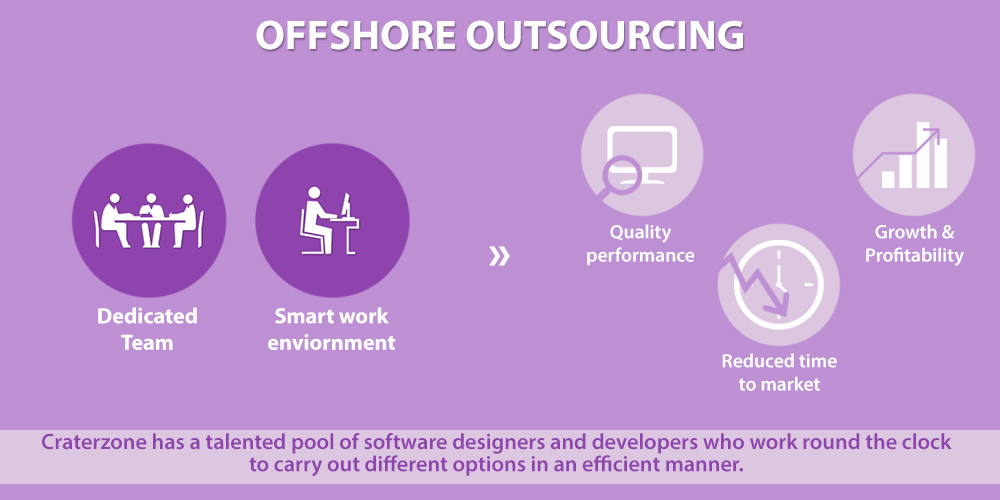
We are a dedicated team of experienced professionals, helping SMEs and  start ups achieve their business objectives by offering dedicated offshore development centre (ODC) services, Our world class team with some of the industry’s most highly qualified professionals understands the need, vision and expectations of the client efficiently.
Armed with expertise in mobility solutions, software development, cloud computing, testing services and digital marketing, we are well-known for providing end-to-end solutions by installing an independent development center and by offering consultation in product development.
Your Trusted ODC Partner
The Offshore Development Centre (ODC) has today become the most-preferred business model for almost all sizes of organizations, helping them in increasing their productivity and reducing their operating costs by leveraging offshore talent. It provides clients greater predictability and visibility during the development process.
The single most important factor to determine a hassle-free migration & transition of activities to an alternative location with outsourcing is to take advantage of the services of a trustworthy ODC partner.
We make sure that you experience comfortably in the course of the entire process of setting up an ODC in India. During the establishing process of an ODC, you are provided with the services of an exclusive developer team, which will be fully focused on your project, and function as a practical extension of your home team.
We use the most advanced technologies to support your project, incorporating impeccably with your organization’s exclusive requirements. Our services are leveraged on the basis of your time-frames and budgets.
Some of the key features of our ODC include:
1. Complete all-round guidance and support from development to maintenance
2. Comparatively affordable yet excellent services
4. Reduced operational and capital costs
5. 24/7 Technical Support and Help
6. Center Of Excellence

One Stop Solution For Outsourced Product Development Needs
We are one stop solution for all kinds of outsourced product development requirements. We don’t just  provide products and services in the field of IT and communication, we also help in generating new business ideas. With expertise in software development, mobile technologies and cloud computing, we give an incubator like environment for the organizations to flourish. The three basic criteria where our strength lies are:
1.     Quality
2.     Speed
3.     Cost

So, call us now at  contact@craterzone.com to know more about our offshore development services.

Saturday, 28 March 2015

Custom Software Development Service for Modern Enterprise


Developing and integration of software products for an organization – in order to be a step ahead of its competition, all the while being able to render its services at low costs - is a key to the ultimate success of a company and its future in the software industry.
Hiring software developers who can apply, make use of, and if needed, ameliorate existing possibilities on the latest platforms, is the strategy being adopted by many these days.  No matter if that’s about redesigning an existing product or developing a new idea into product as per the client’s requirements, the need is to be creative and adept at handling a challenge.
Custom software development is one of the many services that we, at Craterzone, offer and have earned a good reputation by being relevant in the highly competitive market.
Challenges faced by organizations:
·        Develop unique and innovative products and offer solutions adopting latest technology options
·        Comply with regulatory requirements and industry standards
·        Evaluate product designs through virtual prototype and tests
·        Optimize product performance with low development costs.
·        Announce new products in shorter time frame
          
                                      
Exploit our experience and talent for your gains:
We are a fast growing custom software development company, providing solutions, services and products from creating ideas through implementing and designing to production across various industries. We take the following steps to complete the product development life-cycle:
1.     Idea Generation: Generate ideas for new projects using the SWOT analysis (Strengths, Weaknesses and Opportunities & Idea Generation).
2. Idea Screening: We analyses on how the new product will benefit the customer. What could the size and growth be of the target market? What type of pressure to expect from the competition? What is the sale and market trends of the product idea based on? Is it technically feasible and profitable to the customer when the manufactured product is offered at the target price?
3.  Concept development & testing: We develop marketing and engineering details by enquiringly intellectual property issues and check patent databases. We look for the decision maker while deciding on purchasing in the target market. How the product will be beneficial to the consumers and will it be cost-effective.
4. Testing and Pricing product:  Take a survey with the prospective consumers and analyses the likely selling price based on factors like competition, customer feedback, estimated sale and profitability.
5. Technical Implementation & Launch: Initiate the new product. Check on all technical formalities before launching the product. Do elaborate publicity and promotions and do a final critical analysis.
6. Pricing: Consider the impact the new product could create in the market keeping an eye on competition product and price.